
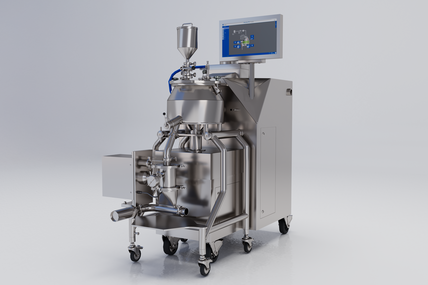
In pharmaceutical manufacturing, every step in the production chain is meticulously designed to ensure the final product’s quality, efficacy, and safety. Our previous article explored the significant benefits of high-shear granulation, highlighting its role in transforming fine powders into uniform granules with enhanced flowability and compressibility. While granulation is a critical process in itself, its true impact resonates far beyond the granulator, directly influencing the efficiency and success of subsequent downstream operations, particularly tableting and tablet coating.
It’s a common misconception that issues arising in tablet presses or coating pans are solely due to the performance of those specific machines. In reality, many downstream challenges, from inconsistent tablet weights to cosmetic defects, often originate much earlier in the process—specifically, during granulation. Understanding this intricate interdependency is key to optimizing the entire manufacturing workflow and consistently producing high-quality solid dosage forms.
The Foundation of Quality: Granulation’s Impact on Tableting Performance
The tablet press is arguably the heart of solid dosage form manufacturing, and its optimal performance hinges almost entirely on the quality of the material it is fed. Poorly prepared granules can lead to a cascade of problems, impacting everything from production speed to the integrity of the final tablet.
1. Correct Die Filling and Weight Uniformity:
One of the most fundamental requirements for a tablet press is consistent die filling, which directly translates to uniform tablet weights. If the granulated material lacks adequate flowability, it can lead to incomplete or inconsistent filling of the dies. This results in tablets with significant weight deviations, which can compromise dose uniformity and, consequently, therapeutic efficacy. Granules produced with inconsistent particle size distribution, irregular shapes, or varying densities will flow unevenly into the dies. High-shear granulation, as discussed previously, excels at producing granules with improved flowability and higher, more uniform bulk densities. This consistency ensures that the tablet press dies are filled accurately and repeatedly, leading to tablets with precise and consistent weights.
2. Mitigating Tablet Defects: Capping, Lamination, and Sticking:
Tablet defects like capping (the top or bottom of the tablet separating), lamination (the tablet splitting into layers), and sticking (material adhering to the punch faces or die walls) are common headaches for manufacturers. These issues are often direct indicators of sub-optimal granule properties:
Capping and Lamination:
These defects typically occur when there is insufficient inter-particulate bonding within the tablet, or when air is entrapped during compression and cannot escape. Granulation plays a vital role in preventing this. If the binder distribution during granulation is uneven, or if the granules themselves are too weak or contain excessive fines, the tablet may not form a cohesive unit. High-shear granulation, with its intense mixing and uniform binder distribution, creates strong, dense granules with robust inter-particle bonds. This enhanced granule strength and reduced friability translate directly into tablets that are less prone to capping and lamination under compression.
Sticking:
Sticking can be caused by several factors, including excessive moisture content in the granules, the presence of low melting point excipients, or rough granule surfaces. While tableting parameters can influence sticking, the root cause often lies in the granulated material. Granules that are too wet or have an inconsistent moisture profile will stick to the punches. High-shear granulation, followed by controlled drying (often in a fluid bed dryer), ensures optimal and uniform moisture content. Furthermore, the more uniform and spherical morphology often achieved with high-shear granulation can result in smoother granule surfaces, reducing the tendency for material to adhere to the tooling.
By optimizing the upstream granulation process—ensuring consistent granule size, shape, density, flowability, and mechanical strength—manufacturers can significantly reduce the incidence of these common tableting defects, leading to higher yields and reduced waste.
From Core to Coat: Granulation and Tableting’s Influence on Tablet Coating
Tablet coating is a critical process for many pharmaceutical products, serving purposes ranging from taste masking and aesthetic appeal to controlled drug release and protection from environmental degradation. The success of the coating process is heavily dependent on the characteristics of the tablet core itself, which in turn are shaped by both granulation and tableting.
1. Granulation’s Influence on Optimal Tablets for Coating:
The properties of the granules directly impact the final tablet core, which then dictates how well the coating adheres and performs:
Granule Density and Porosity:
High-shear granulation typically produces denser granules. This influences the porosity of the final tablet. An optimal level of porosity is crucial for uniform coating adhesion and film formation. If the tablet is too porous, it can absorb too much coating solution, leading to a rough, uneven surface or even cracking. If it’s too dense, the coating may not adhere well.
Surface Roughness:
The morphology of the granules, which is a direct outcome of the granulation process, affects the surface roughness of the compressed tablet. Uniform, well-formed granules tend to produce tablets with smoother surfaces. A smoother tablet surface is ideal for coating, as it promotes even film formation, reduces the amount of coating material required, and results in a more aesthetically pleasing final product.
Mechanical Strength:
Strong, robust granules translate into strong tablet cores. Tablets with insufficient mechanical strength (e.g., high friability) are prone to chipping, abrasion, or even breaking during the rigorous tumbling action within the coating pan. This can lead to coating defects, product loss, and extended processing times.
2. Tableting’s Influence on Optimal Tablets for Coating:
While granulation provides the raw material, the tableting process itself puts the finishing touches on the core tablet’s properties that are critical for coating:
Tablet Hardness and Friability:
The compression force applied during tableting determines the tablet’s hardness and friability. An optimal balance is required: tablets must be hard enough to withstand handling and coating without breaking, but not so hard that they become difficult to coat uniformly or disintegrate poorly. Low friability is paramount to prevent chipping and dusting during coating.
Tablet Shape and Surface Area:
The design of the tablet (e.g., biconvex, flat-faced, capsule-shaped) and its consistency in shape and size are crucial. Irregularly shaped tablets or those with inconsistent dimensions will experience uneven exposure to the coating spray, leading to non-uniform film thickness and potential defects. The total surface area also influences the amount of coating material needed and the drying efficiency.
Absence of Defects:
As discussed earlier, tablets free from capping, lamination, or sticking are absolutely essential for a successful coating process. Any surface defect on the core tablet will be magnified by the coating, leading to an unacceptable final product.
The Ideal Tablet for Coating:
Considering both upstream processes, the optimal tablet core for coating is characterized by: uniform size and shape, consistent density and porosity, a smooth and defect-free surface, adequate hardness, and low friability. These attributes ensure optimal adhesion, uniform film thickness, and a robust, high-quality final coated tablet.
Conclusion
The pharmaceutical manufacturing landscape is a complex interplay of interconnected processes. The quality of the final tablet, whether it’s an immediate-release or a complex controlled-release formulation, is a direct reflection of the meticulous control exercised at every stage. Investing in optimized upstream processes, particularly advanced granulation techniques like high-shear granulation, is not merely about producing better granules. It’s about laying a robust foundation that inherently solves many common challenges encountered in downstream tableting and tablet coating. By understanding and leveraging these critical interdependencies, manufacturers can achieve greater process efficiency, reduce waste, and, most importantly, consistently deliver high-quality, safe, and effective medications to patients.
About Romaco Contact us