
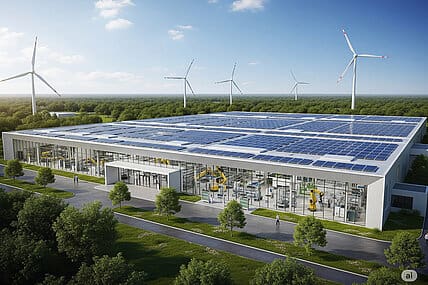
The urgent demand for carbon neutrality is transforming industrial manufacturing. Global sustainability goals and regulations compel industries, especially pharma and packaging, to adopt eco-friendly methods. This shift ensures compliance, maintains market leadership, and enhances brand integrity. Romaco supports this vital journey with advanced, sustainable solutions for a greener future.
Discover how Romaco’s Sustainable Manufacturing Solutions help industries transition toward carbon neutrality.
1. Understanding Carbon-Neutral Factories
A carbon-neutral factory is an industrial facility that achieves a net-zero release of carbon dioxide (CO2) emissions into the atmosphere. This is accomplished by balancing the amount of CO2 released with an equivalent amount removed or offset. The path to carbon neutrality typically involves a combination of reducing emissions at the source, switching to renewable energy, and offsetting unavoidable emissions.
In the pharmaceutical and packaging industries, key sources of carbon emissions include:
- Energy consumption: Heating, cooling, ventilation, and powering machinery (Scope 1 & 2 emissions).
- Raw material extraction and processing: The energy and processes involved in producing materials like plastics, glass, metals, and certain chemical excipients (Scope 3 emissions).
- Transportation: Logistics across complex supply chains (Scope 3 emissions).
- Waste generation: Disposal of manufacturing by-products and packaging waste.
The benefits of transitioning to low-emission production are multifaceted:
- Compliance with global sustainability regulations: Adhering to international agreements like the Paris Agreement and regional initiatives such as the EU Green Deal.
- Cost savings through energy efficiency: Reducing energy consumption directly translates to lower operational costs and increased competitiveness. For instance, some companies have achieved significant steam energy savings through heat recovery systems in tablet coating, demonstrating tangible economic benefits.
- Improved brand reputation and customer trust: Consumers and stakeholders increasingly demand environmentally responsible practices, making sustainability a key differentiator in the market.
Explore Romaco’s Energy-Efficient Equipment designed for sustainable manufacturing.
2. Strategies for Reducing Industrial Carbon Emissions
Achieving carbon neutrality requires a multi-pronged approach, integrating technological advancements with strategic operational changes.
- Energy-Efficient Manufacturing Equipment
Modern pharmaceutical and packaging machinery is engineered to minimize energy consumption without compromising performance. This includes optimized motor designs, intelligent control systems, and streamlined processes that reduce energy waste. Beyond individual machine efficiency, the integration of energy recovery systems in production lines is crucial. These systems capture waste heat or energy from one process to be reused in another, significantly reducing the overall energy footprint. For example, heat recovery systems in fluid bed drying or tablet coating can lead to substantial energy savings, sometimes up to 50% for thermal energy.
Romaco’s High-Efficiency Processing Equipment is engineered to reduce energy waste while optimizing performance, leading to substantial operational savings and a smaller environmental footprint.
- Transitioning to Renewable Energy Sources
A fundamental step towards decarbonization is the adoption of renewable energy sources such as solar, wind, and hydro power to directly fuel factory operations. Many leading industries are integrating large-scale renewable energy installations or purchasing certified renewable energy to power their facilities. This transition drastically cuts down Scope 2 emissions, which originate from the generation of purchased electricity. Case studies across various sectors demonstrate successful integrations, proving the feasibility and long-term economic benefits of such investments.
Learn how Romaco supports Sustainable Manufacturing Practices by developing machinery compatible with evolving energy landscapes and supporting our customers in their renewable energy transition.
- Smart Monitoring & AI-Based Optimization
The advent of the Industrial Internet of Things (IIoT) and artificial intelligence (AI) has revolutionized energy management in factories. IoT sensors collect real-time data on energy consumption across all machinery and processes. AI-driven analytics then process this vast amount of data to identify inefficiencies, predict maintenance needs, and optimize energy usage patterns. This real-time optimization minimizes energy waste, ensures peak operational efficiency, and facilitates proactive adjustments to production schedules to align with energy availability or cost.
- Sustainable Packaging & Material Optimization
Beyond the manufacturing process itself, the choice of packaging materials plays a significant role in achieving carbon neutrality. The packaging industry is rapidly innovating, developing eco-friendly packaging solutions that are biodegradable, recyclable, or made from recycled content. Innovations include paper-based blisters, compostable films, and lightweight designs that reduce material usage. This not only minimizes waste but also reduces the carbon emissions associated with material production and end-of-life disposal. Romaco is actively involved in these developments, offering machinery capable of processing new sustainable materials.
Discover Romaco’s Sustainable Packaging Machinery, designed to handle innovative eco-friendly materials and reduce packaging waste, supporting a circular economy.
- Carbon Capture & Offsetting Programs
For emissions that cannot be entirely eliminated through reduction and renewable energy strategies, industries can invest in carbon capture technologies or offsetting programs. Carbon capture technologies aim to capture CO2 directly from industrial emissions or the atmosphere. Carbon offsetting involves investing in projects that reduce greenhouse gas emissions elsewhere, such as afforestation, renewable energy projects in developing countries, or methane capture from landfills. While offsetting should be a last resort after maximizing reduction efforts, it provides a crucial mechanism to achieve net-zero emissions.

3. The Role of Regulations & Certifications in Carbon-Neutral Factories
The global push for carbon neutrality is heavily influenced by international agreements and national regulations. The Paris Agreement, for instance, sets a global framework for climate action, urging countries to achieve net-zero emissions by mid-century. The EU Green Deal outlines ambitious targets for Europe to become the first climate-neutral continent. These overarching goals cascade down into industry-specific regulations that mandate emissions reductions, energy efficiency standards, and sustainable practices.
Furthermore, various certifications provide a verifiable framework for companies demonstrating their commitment to sustainability.
- ECOVADIS: A globally recognized standard for assessing corporate social responsibility and sustainable procurement, providing ratings across environmental, labor & human rights, ethics, and sustainable procurement themes.
- LEED (Leadership in Energy and Environmental Design): A widely used green building rating system that assesses environmental performance of buildings, including industrial facilities, covering aspects like energy efficiency, water savings, and sustainable materials.
- ISO 14001: An international standard that specifies requirements for an effective environmental management system (EMS), helping organizations systematically manage their environmental impacts.
- PAS 2060: An internationally recognized specification for demonstrating carbon neutrality, providing a methodology for quantifying, reducing, and offsetting greenhouse gas emissions.
Romaco helps companies comply with sustainability standards by providing machinery and solutions that contribute to lower energy consumption, reduced waste, and the ability to process eco-friendly materials, thereby supporting certification efforts. Romaco is also gold rated by ECOVADIS.
Contact Romaco for tailored solutions to meet carbon-neutral regulations.
4. How Romaco Supports Carbon-Neutral Manufacturing
Romaco is deeply committed to sustainable innovation, embedding eco-friendly principles into the core of its product development and service offerings. Our dedication to sustainability is reflected in a comprehensive portfolio designed to facilitate the pharmaceutical and packaging industries’ transition to carbon-neutral operations.
Romaco’s contributions include:
- Energy-efficient pharmaceutical & packaging machines: Our state-of-the-art equipment minimizes energy consumption through optimized designs, advanced controls, and integrated energy recovery systems, significantly reducing operational footprints. Romaco Innojet’s heat recovery systems, for example, can recover substantial thermal energy in granulation and coating processes.
- Monitoring systems for reduced energy waste: Romaco’s energy monitor solutions provide real-time data on machine performance and energy usage. This allows for predictive maintenance, optimized process control, and immediate identification of energy inefficiencies, leading to substantial waste reduction.
- Sustainable packaging machinery & materials: Romaco offers machines capable of handling a new generation of eco-friendly packaging materials, such as paper-based blisters and trays, supporting the industry’s move away from plastics and towards more recyclable and biodegradable solutions. Our solutions enable customers to implement sustainable packaging strategies effectively.
Explore Romaco’s Eco-Friendly Solutions to transition toward carbon neutrality and contribute to a more sustainable future for pharmaceutical and packaging industries.
Conclusion
The shift towards carbon-neutral factories is no longer a distant aspiration but an immediate necessity driven by global environmental goals, stringent regulations, and evolving market demands. By embracing efficient technology, transitioning to renewable energy, implementing smart monitoring, and adopting sustainable packaging solutions, industries can significantly reduce their carbon emissions. This transition benefits not only the planet by mitigating climate change but also businesses themselves through cost savings, enhanced brand reputation, and future-proofing against stricter regulations.
Romaco is proud to be a partner in this vital journey, offering cutting-edge solutions that enable pharmaceutical and packaging manufacturers to achieve their sustainability objectives without compromising on quality or efficiency.
Get in touch with Romaco to explore cutting-edge solutions for sustainable manufacturing and emissions reduction, and let’s build a greener future together.
About Romaco Contact us