
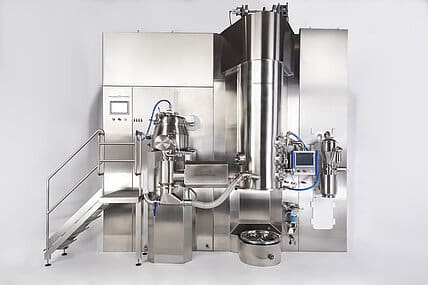
Pharmaceutical manufacturing relies heavily on robust and efficient processes to ensure the consistent production of high-quality medications. Granulation, a crucial step in the production of many solid dosage forms. It transforms fine powder particles into larger, more uniform granules. This enhances material flowability, compressibility, and uniformity, making it more suitable for downstream processing, such as tablet compression or capsule filling. High-shear granulation has emerged as a prominent technique within the pharmaceutical industry, offering numerous advantages. This article will delve into the intricacies of high-shear granulation, highlighting its benefits and exploring its impact on the pharmaceutical landscape.

1. What is Granulation in the Pharmaceutical Industry?
Granulation is a fundamental unit operation in pharmaceutical manufacturing aimed at improving the physical and technological properties of powdered materials. By agglomerating fine particles into larger granules, several critical challenges are addressed. Firstly, granulation enhances powder flowability, preventing clogging and ensuring consistent material transfer during subsequent processing steps such as filling capsules or feeding tablet presses. Secondly, it improves the compressibility of the powder, enabling the formation of strong and uniform tablets with desired disintegration properties. Finally, granulation can contribute to improved drug stability by protecting active pharmaceutical ingredients (APIs) from environmental factors such as moisture and oxidation.
Two primary types of granulation are commonly employed: High shear granulation involves the addition of a liquid binder to the powder mixture, followed by high-speed mixing in a high shear mixer. Subsequently, the wet granules are transferred into a fluid bed processor for drying. Fluid bed granulation is another common wet granulation technique, where the powder bed is fluidized with air while the binder is sprayed in. Granule build-up and drying is performed at the same time.
The Advantage of high shear granulation is a higher density of the resulting granules while raw materials with high variation in density and particle size can be processed. The advantage of fluid bed granulation is the creation of granules with smaller PSD while the process takes place in only one processor what provides advantages in containment.
2. Understanding High-Shear Granulation
High-shear granulation is a dynamic process that utilizes high-speed mixing equipment to rapidly and efficiently produce granules. Unlike traditional methods, which may rely on slower mixing speeds, high-shear granulators employ powerful impellers that generate intense shear forces within the powder bed. This intense shearing action effectively breaks down larger agglomerates, distributes the liquid binder uniformly, and promotes rapid granule formation.
The process typically involves three key stages:
- Mixing: The powder blend, including the API and excipients, is initially mixed in the granulator.
- Wetting: The liquid binder, such as water, alcohol, or a binder solution, is introduced into the mixing chamber. The high-shear forces ensure rapid and even distribution of the binder throughout the powder mass.
- Granule Formation: As the binder interacts with the powder particles, it acts as a bridge, forming cohesive bonds and creating granules. The intensity of the shear forces plays a crucial role in controlling granule size and morphology.
3. Advantages of High-Shear Granulation in Pharmaceutical Manufacturing
High-shear granulation offers several significant advantages over traditional methods:
- Improved Granule Uniformity: The intense shear forces generated by high-shear mixers result in more uniform particle size and density distribution within the granule population. This consistency is crucial for achieving predictable and reliable tablet properties.
- Enhanced Tablet Compressibility: The strong interparticle bonds formed during high-shear granulation lead to improved tablet compressibility, resulting in tablets with greater strength and integrity.
- Increased Production Efficiency: High-shear granulators can process larger batches of material in shorter timeframes compared to traditional methods, leading to increased production output and reduced cycle times.
- Flexibility with Formulations: High-shear granulation is compatible with a wide range of APIs and excipients, offering flexibility in formulation development.
- Reduced Material Loss: Efficient mixing and controlled granulation processes minimize dust generation and material loss, improving overall yield and reducing production costs.
- Improved Drug Stability and Bioavailability: Consistent and well-defined granule properties contribute to improved drug stability and bioavailability, ensuring that the medication delivers its therapeutic effect effectively.
4. Applications of High-Shear Granulation in the Pharmaceutical Industry
High-shear granulation finds widespread application across various areas of pharmaceutical manufacturing:
- Tablet Production: It is extensively used in the production of tablets, including immediate-release, controlled-release, and modified-release formulations.
- Capsule Filling: High-shear granulation produces granules with excellent flowability, making them suitable for filling capsules accurately and efficiently.
- Sachet Formulation: Granulates produced by high-shear granulation can be easily packaged into sachets for convenient oral administration.
- Nutraceuticals: The technology is also employed in the production of nutraceuticals, including vitamins, minerals, and dietary supplements.
- Biotechnology: High-shear granulation finds applications in the processing of biologics, such as protein powders and other biopharmaceuticals.
5. Choosing the Right Granulation Equipment
To select the appropriate granulation equipment the following key factors should be considered:
- Batch Size and Scalability: The equipment should be able to accommodate the desired production volumes and easily scale up or down as needed.
- Material Properties: The properties of the API and excipients, such as particle size, density, and hygroscopicity, will influence the choice of granulator.
- Regulatory Compliance: The equipment must comply with Good Manufacturing Practices (GMP) and other relevant regulations.
- Ease of Cleaning and Maintenance: Hygienic design and easy access for cleaning are essential for maintaining product quality and preventing cross-contamination.
- Automation and Advanced Controls: Integration with process analytical technology (PAT) and advanced control systems can enhance process consistency, improve data management, and facilitate real-time process optimization.
6. Challenges and How High-Shear Granulation Addresses Them
Common challenges encountered in traditional granulation processes include:
- Poor Powder Flowability and Compressibility: High-shear granulation effectively addresses these challenges by producing granules with improved flowability and compressibility, facilitating subsequent processing steps.
- Variations in Particle Size and Moisture Content: The intense mixing and controlled processing conditions in high-shear granulators contribute to more uniform particle size distribution and consistent moisture content within the granules.
- High Wastage During Production: By minimizing dust generation and optimizing the granulation process, high-shear technology helps to reduce material loss and improve overall yield.
7. Future Trends in High-Shear Granulation Technology
The future of high-shear granulation lies in continuous innovation and integration with emerging technologies. Key trends include:
- Integration of Automation and AI: The increasing integration of automation and artificial intelligence (AI) will enable real-time process monitoring, predictive maintenance, and intelligent process control, further enhancing efficiency and consistency.
- Development of Sustainable and Energy-Efficient Equipment: The focus on sustainability will drive the development of more energy-efficient granulators with reduced environmental impact.
- Innovations for Handling Highly Potent APIs and Biologics: Advancements in containment technology and process design will enable the safe and efficient processing of highly potent APIs and biologics using high-shear granulation techniques.
Conclusion
High-shear granulation has emerged as a critical technology in modern pharmaceutical manufacturing, offering numerous advantages over traditional methods. By improving granule uniformity, enhancing compressibility, and increasing production efficiency, high-shear granulation plays a crucial role in ensuring the consistent production of high-quality medications. Romaco’s IGL, an integrated granulation line, exemplifies this advancement. By seamlessly integrating high-shear granulation with downstream processes such as drying and milling, the IGL optimizes production workflows and delivers exceptional results. As the industry continues to evolve, ongoing advancements in high-shear granulation technology, coupled with innovative solutions like the Romaco IGL, will continue to shape the future of pharmaceutical manufacturing.
FAQ
What is a high shear granulator?
A high shear granulator is a specialized piece of industrial equipment used to convert fine powders into dense, high-quality granules. By using a high-speed impeller and a chopper, the machine applies intense mechanical force (shear) to a powder bed in the presence of a liquid binder. This process is essential for creating uniform mixtures in the pharmaceutical, chemical, and food industries.
How does a high shear mixer granulator work?
The process typically follows four distinct stages:
- Dry Mixing: The high-speed impeller creates a vortex, ensuring a homogenous blend of dry ingredients.
- Wetting: A liquid binder is added to the powder bed.
- Granulation: The impeller facilitates nucleation, while the high-speed chopper breaks down large lumps to control granule size.
- Drying/Discharge: The resulting “wet mass” is prepared for subsequent drying, often in a fluid bed dryer.
What are the advantages of high shear granulation equipment?
High shear granulation is preferred for its efficiency and precision. Key benefits include:
- Reduced Processing Time: Significant granulation is achieved in minutes rather than hours.
- High Granule Density: Produces compact, less porous granules compared to other methods.
- Low Binder Requirement: Requires less liquid to achieve effective granulation.
- Predictability: Offers excellent control over the final granule size and distribution.
Why is high shear granulation used in pharmaceutical manufacturing?
In pharmaceutical manufacturing, high shear granulation is critical for ensuring content uniformity in solid dosage forms. It improves the flow properties and compressibility of powders, which is vital for high-speed tablet pressing. By preventing the segregation of active pharmaceutical ingredients (APIs) and excipients, it ensures that every tablet contains the exact intended dose.
What are the types of granulation processes?
Granulation is generally categorized into three primary methods based on whether a liquid solution is used:
- Wet Granulation: The most common method, involving high shear granulation, fluid bed granulation, or twin-screw granulation. It uses a liquid binder to facilitate particle bonding.
- Dry Granulation: Used for moisture-sensitive or heat-sensitive materials. This includes roller compaction and slugging, where granules are formed through high-pressure mechanical compression without liquids.
- Melt Granulation: A specialized process where a heat-activated binding agent is used instead of a solvent.