
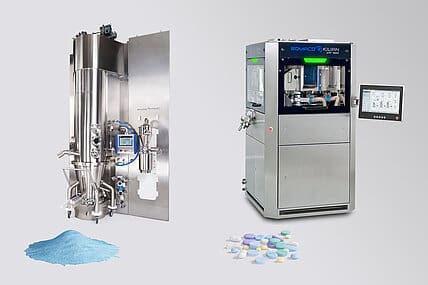
The pharmaceutical and nutraceutical industries are growing at an unprecedented pace, driven by increasing consumer demand and stricter regulatory requirements. For Business-to-Business (B2B) manufacturers, this means one thing: the need for greater efficiency, precision, and scalability in production.
To stay competitive, manufacturers are turning to advanced processing technologies that can deliver consistent product quality at high throughput. Among the most transformative solutions are tablet press machines and fluid bed technologies. These systems are no longer just production equipment – they are becoming the backbone of modern pharmaceutical and nutraceutical manufacturing lines.
In this article, we’ll explore how innovations in tablet press and fluid bed technologies are reshaping B2B manufacturing and why integrated solutions are the key to future-proofing your production lines.
Understanding Tablet Press Technology in Modern Manufacturing
A tablet press, or tablet compression machine, is one of the most critical pieces of equipment in pharmaceutical manufacturing. It compresses powder or granulated materials into uniform tablets that meet exacting standards for weight, thickness, and hardness.
Key Advancements in Tablet Press Technology
Precision tablet compression
Modern tablet presses use advanced die and punch designs coupled with real-time monitoring to achieve unparalleled accuracy. This ensures every tablet is uniform, which is vital for dosing consistency and regulatory compliance.
High-speed production capabilities
Today’s tablet presses can produce millions of tablets per hour without compromising quality. This scalability is crucial for high-volume manufacturers in pharmaceuticals and nutraceuticals.
Consistent weight and hardness control
Sophisticated sensors and feedback loops detect even minor deviations, making real-time adjustments during production. This level of quality control reduces product rejects and maximizes yield.
Automation and data monitoring
Automated systems reduce manual intervention, cutting labor costs and minimizing contamination risks. Integrated software solutions provide real-time monitoring and data-driven insights, which enable predictive maintenance and continuous process improvement.
The Role of Fluid Bed Technologies in Product Quality
Fluid bed technology plays a vital role in pharmaceutical and nutraceutical production, particularly in drying, granulation, and coating processes. This technique suspends product particles in a controlled flow of hot air, ensuring even distribution and processing. After the product has been successfully fluidized, it is either dried or sprayed with a solution for granulation or coating.
Key Advancements in Fluid Bed Systems
Faster processing times
Improved airflow designs and heat transfer mechanisms significantly shorten drying and granulation cycles, increasing overall production throughput.
Uniform coating and drying
Uniform particle fluidization ensures consistent coating thickness and moisture content, which directly enhances product quality.
Energy-efficient designs
Romaco Innojet fluid bed dryers and granulators are already equipped with a unique heat recovery system, making them more sustainable and reducing costs.
By reducing processing time, improving consistency, and lowering energy consumption, fluid bed technologies help manufacturers achieve higher batch quality while cutting operational costs.
Integration of Tablet Press and Fluid Bed Systems for Seamless Production
Integrating tablet press machines with fluid bed dryers and granulators can transform a traditional production line into a highly efficient, fully automated system.
Benefits of Integrated Systems
- Improved throughput: Automated material transfers reduce downtime between processes.
- Reduced manual intervention: Integration lowers contamination risks and labor costs.
- Enhanced process control: Centralized data systems monitor every stage, enabling predictive maintenance and real-time adjustments.
By combining these technologies, B2B manufacturers can achieve higher productivity and more consistent results, paving the way for Industry 4.0-ready manufacturing lines.
Key Benefits for B2B Manufacturers
Investing in advanced tablet press and fluid bed technologies offers multiple advantages:
Faster production cycles
Shorter processing times and higher throughput mean you can meet market demands quickly.
Lower operational costs
Automation reduces manual labor, while energy-efficient designs cut utility expenses.
Improved product quality and compliance
Enhanced monitoring and process control ensure regulatory standards are consistently met.
Scalability for high-volume production
Modern systems are designed to scale as your business grows.
Real-time monitoring and data-driven decisions
Digital integration provides actionable insights that improve operational efficiency.
Real-World Application
Consider a leading pharmaceutical company that recently invested in an integrated Romaco Kilian tablet press and Romaco Innojet fluid bed processing line. Within six months, they reported:
- A quarter increase in throughput,
- Manual handling reduced by almost half,
- Near-zero batch rejections,
- And a significant drop in energy consumption.
This success story highlights how integrated technologies can dramatically improve both productivity and profitability.
The Future: Smart, Sustainable, and Automated Solutions
The next evolution in tablet press and fluid bed technologies is centered around smart manufacturing and sustainability.
Internet of Things (IoT) integration and predictive maintenance
Machines will communicate with each other, enabling real-time monitoring and automatic adjustments to prevent downtime.
Sustainability
Energy-saving designs, waste reduction technologies, and recyclable materials will continue to lower the environmental impact of pharmaceutical manufacturing.
As a leading tablet press and fluid bed manufacturer, Romaco is at the forefront of developing systems that meet these evolving needs.
Conclusion
The pharmaceutical and nutraceutical industries cannot afford inefficiencies. Advanced tablet press machines and fluid bed technologies are no longer optional – they are essential for manufacturers seeking to stay competitive in a global market.
By adopting integrated solutions, B2B manufacturers can increase throughput, reduce costs, enhance quality, and prepare for the fully automated factories of the future.
Is your production line ready for the future?
At Romaco Kilian and Romaco Innojet, we specialize in designing advanced tablet press machines and fluid bed processing systems that help B2B manufacturers achieve unmatched efficiency and scalability.
Contact us today for a free expert consultation or to schedule a product demonstration.
Explore our latest tablet press and fluid bed solutions and discover how we can help future-proof your manufacturing operations.