
Introduction
Fluid bed dryers have revolutionized the drying process across various industries, including pharmaceuticals. By suspending particles in a fluidized bed of air, these dryers offer superior drying efficiency, product quality, and process control compared to traditional methods. Romaco has been at the forefront of developing advanced fluid bed granulator/dryer technology, setting new standards for the industry.
Traditional ancient Granulation/Drying Methods
Inconsistent Drying: Traditional drying methods, such as tray drying, oven drying, and drum dryers, have been used for decades. These methods involve placing wet materials on trays or within a rotating drum and exposing them to heat. While effective for certain applications, they often suffer from limitations:
Inconsistent Drying:
Traditional methods often lead to uneven drying, resulting in product quality variations.
Longer Drying Times:
These methods typically require longer drying cycles compared to fluid bed dryers.
Increased Risk of Contamination:
Open systems like tray drying are susceptible to contamination.
Inefficient Energy Consumption:
Traditional methods often consume more energy due to their lower efficiency.
While advanced technologies like fluid bed dryers have gained prominence due to their efficiency and product quality advantages, there are still instances where traditional methods are preferred or necessary:
Small-scale production:
For low-volume production or batch processing, tray drying or oven drying can be cost-effective.
Heat-sensitive materials:
In certain cases, where products are extremely sensitive to heat, tray drying under controlled conditions might be preferred.
Specific product requirements:
Some products might have unique drying characteristics that necessitate the use of traditional methods.
However, it’s important to note that these traditional methods are generally less efficient, slower, and carry a higher risk of contamination compared to modern technologies like fluid bed dryers. As a result, their usage has significantly decreased in many pharmaceutical operations.
Traditional modern Granulation/Drying Methods (Wurtser)
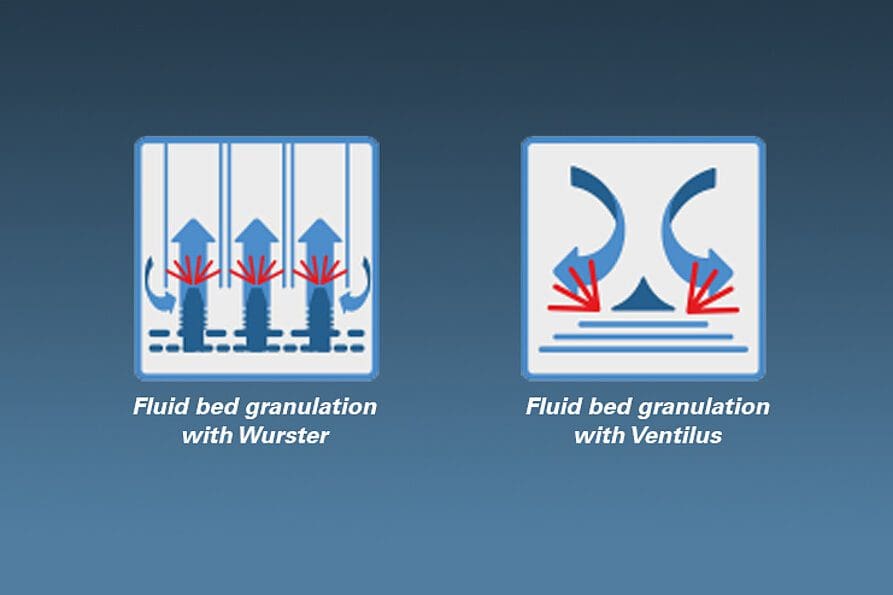
The Wurster process involves a cylindrical granulator with a central air inlet and spray nozzles positioned around the circumference. Product is fed into the top of the cylinder and is fluidized by the upward flow of air. The binding solution is sprayed onto the product as it circulates within the cylinder.
Romaco’s Fluid Bed Granulator/Dryer Technology (Ventilus)
Romaco’s Innojet Ventilus is a fluid bed processor equipped with the Orbiter plate and Rotojet spray system. The Orbiter plate creates a unique air flow pattern within the fluid bed, ensuring optimal mixing and drying conditions. The Rotojet spray system provides precise and uniform liquid distribution.
Comparison between Wurster and Ventilus Technology
| Feature | Wurster Granulation | Romaco Innojet Ventilus |
| Granulation Mechanism | Spraying binding solution onto circulating product (small quantities) with multiple columns and nozzles | Fluidized bed with orbital air flow and precise spray distribution (one nozzle) |
| Air Flow | Upward air flow inner part of the column through the cylinder | Unique orbital air flow pattern created by the Orbiter plate |
| Product Distribution | Product circulates within the cylinder |
Product is evenly suspended in the fluidized bed |
| Spray Distribution | Spray nozzles positioned around the cylinder | Rotojet spray system for precise and uniform liquid distribution |
| Drying Efficiency | Can be less efficient due to uneven drying | Highly efficient due to uniform air distribution and optimized drying conditions |
| Product Quality | Potential for product degradation due to impact and friction | Gentle product handling preserves product integrity and much faster process |
| Flexibility | Less flexible in terms of process parameters. Split of the batch, pending WG can be foreseen | Highly flexible with adjustable air flow, temperature, and spray patterns |
| Cleaning and Maintenance | Can be challenging due to product build-up | Easier cleaning and maintenance due to open design |
Advantages of Romaco Innojet Ventilus
Improved Product Quality:
The gentle fluidization and precise spray distribution result in higher product quality with minimal degradation.
Increased Efficiency:
The optimized air flow and drying conditions lead to faster drying times and reduced energy consumption.
Enhanced Flexibility:
The ability to adjust air flow, temperature, and spray patterns allows for processing a wider range of products.
Simplified Cleaning:
The open design of the Innojet makes cleaning and maintenance easier and faster.
You may also read: A High-Efficiency Processing Solution for Drying, Granulation and Coating
While the Wurster process remains a viable option for certain applications, Romaco Innojet Ventilus offers significant advancements in terms of product quality, efficiency, and flexibility.
Key Problems of Wurster Technology
Non-uniform drying:
Due to the cylindrical design and upward air flow, product distribution within the Wurster can be uneven, leading to inconsistent drying and potential product degradation.
Product damage:
The tumbling action in the Wurster can cause abrasion and impact on the product, resulting in particle size reduction and affecting product quality.
Cleaning difficulties:
The cylindrical design and potential product build-up can make cleaning and maintenance time-consuming and labor-intensive.
Limited flexibility:
The Wurster process is less adaptable to different product types and batch sizes compared to the Innojet Ventilus.
Lower efficiency:
The Wurster process often requires longer drying times and higher energy consumption due to less efficient heat and mass transfer.
Romaco Innojet Ventilus technology addresses these challenges by providing a more efficient, gentle, and flexible granulation and drying process.
Customer Success Stories
Numerous customers have successfully implemented Romaco’s fluid bed granulator/dryers, experiencing significant improvements in their production processes compared to traditional systems like Wurster. Testimonials highlight enhanced product quality, increased efficiency, and reduced operating costs. These success stories underscore the reliability and effectiveness of Romaco’s technology.
Conclusion
In summary, Romaco Innojet Ventilus technology offers a versatile and efficient solution for a wide range of applications, providing superior product quality and process control compared to ancient traditional methods and Wurster granulation. Romaco’s fluid bed granulation/drying technology has become an indispensable tool in the pharmaceutical industry. If you are seeking to optimize your drying processes and achieve consistent, high-quality results, consider implementing Romaco’s fluid bed technology.