
Serialization in Pharma Packaging: Rising Importance and Global Trends
Serialization in pharma has become an increasingly critical aspect of pharmaceutical packaging. As supply chains grow more complex and the risk of counterfeit medicines continues to rise, manufacturers are seeking ways to ensure every unit of medication can be reliably identified and traced. Track and trace systems are no longer optional; they are integral to protecting patients, maintaining regulatory compliance, and enhancing supply chain visibility.
Globally, regulators are driving this shift through stringent requirements. Initiatives such as the European Union Falsified Medicines Directive (FMD) and the U.S. Drug Supply Chain Security Act (DSCSA) mandate serialization at the unit level and require comprehensive track and trace capabilities throughout the distribution network. These frameworks are pushing pharmaceutical companies to adopt robust, technology-enabled solutions that safeguard both product integrity and patient trust.
By embedding serialization and track and trace capabilities into primary and secondary packaging, Romaco helps manufacturers meet regulatory expectations while optimizing operational efficiency. Their equipment enables accurate coding, verification, and data management, forming the backbone of a modern, traceable packaging ecosystem.
What Is Serialization in Pharma Packaging?
Serialization in pharma refers to the process of assigning a unique identifier to each individual medicine pack. This unique code, often a combination of numbers and/or QR/DataMatrix codes, allows every unit to be tracked throughout the supply chain. Each code is generated and recorded in a centralized system, linking the physical product to digital information such as manufacturing details, batch numbers, and expiration dates.
These unique codes are tightly connected to track and trace systems, which monitor the journey of each pack from production to distribution to the pharmacy or hospital. By enabling real-time verification and authentication, serialization ensures that every unit can be traced back to its origin. It is mandatory in many markets, including the European Union (FMD), the United States (DSCSA), India (DAVA), and others, reflecting a global regulatory push to prevent counterfeit medicines and protect patient safety.
An example? A pack of tablets leaving a manufacturing facility in Germany receives a unique DataMatrix code. At every checkpoint—warehouse, distributor, pharmacy—the code can be scanned to verify authenticity and confirm its origin, ensuring only legitimate medicines reach patients.
Why Serialization Matters for Pharmaceutical Packaging
Serialization brings several tangible benefits for pharmaceutical manufacturers, healthcare providers, and patients:
-
Ensuring patient safety – Serialization supports anti-counterfeit technologies and ensures that only verified medicines reach the market.
-
Meeting compliance & regulations – Helps companies adhere to requirements from authorities like the FDA, EU FMD, India DAVA, and other local agencies.
-
Building supply chain transparency – Enables detailed visibility of product movement, improving recall management and operational efficiency.
-
Enhancing trust – Patients, pharmacists, and healthcare providers gain confidence in the authenticity of medicines.
Track and Trace in Pharmaceutical Packaging
Track and trace systems are the backbone of serialization in pharma, enabling end-to-end visibility of every medicine pack as it moves through the supply chain. Once a unique code is applied at the unit level, it can be scanned and verified at multiple stages—production, warehouse, distribution, and dispensing—ensuring that only authentic products reach patients.
A critical element of track and trace is aggregation, which links smaller packaging units to larger transport units. For example, individual blister packs are grouped into cartons, cartons are loaded into cases, and cases are placed on pallets. Each level carries a unique identifier that connects to the identifiers of the units it contains. This hierarchy allows manufacturers and distributors to scan a single pallet or case and instantly verify all the packs within, streamlining logistics, reducing manual handling, and supporting rapid recalls if necessary.
Example: A batch of capsules is packed into blisters, divided into 100 cartons, which are then consolidated into 10 cases on a pallet. By scanning the pallet code at the distribution center, the system automatically recognizes all cartons and individual packs it contains, verifying authenticity and confirming shipment details. This not only enhances supply chain transparency but also ensures compliance with regulatory track and trace requirements, giving healthcare providers and patients confidence in the integrity of the medicines they receive.
The Romaco Advantage in Serialization
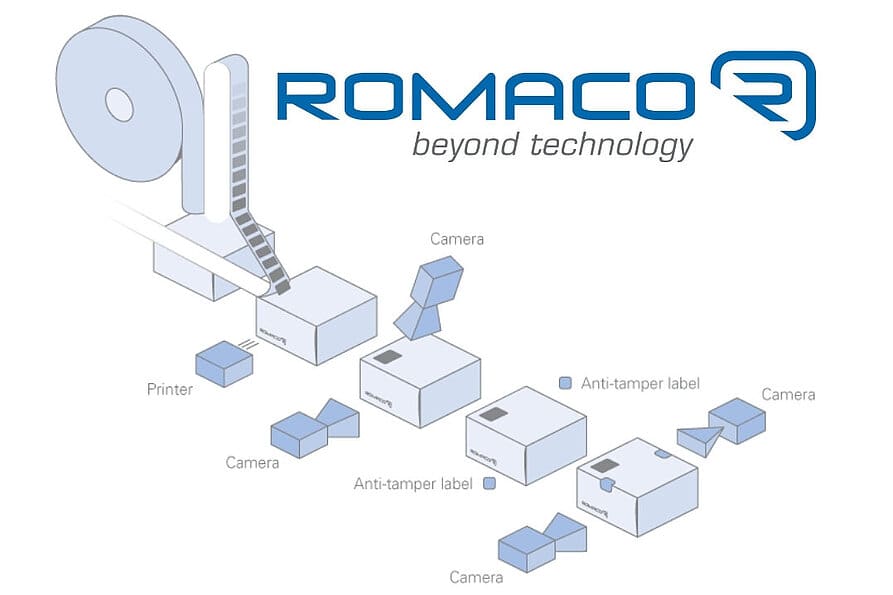
Romaco offers a comprehensive portfolio of serialization and track & trace solutions designed to meet the evolving demands of pharmaceutical packaging. Central to this portfolio is the PTT machine, which enables precise printing, verification, and recording of unique codes on primary and secondary packaging, plus tamper evident. On the tertiary packaging side, PAK case packers with Case Carry modules support aggregation, linking cartons, cases, and pallets seamlessly for full supply chain traceability.
Key features of Romaco’s serialization solutions include:
- High-speed printing & verification – Supports accurate application of DataMatrix codes and integrates easily with the printer, software, and camera system of the customer’s choice.
- Tamper-evident packaging integration – Combines serialization with patient-centric, anti-tamper designs for added safety and compliance.
- Modular and adaptable systems – Equipment can be updated or reconfigured to meet new regulatory requirements or market-specific standards.
- Aggregation-ready technology – Ensures efficient case and pallet-level traceability, enabling rapid scanning, verification, and supply chain transparency.
Globally, pharmaceutical manufacturers trust Romaco for its combination of innovation, flexibility, and regulatory compliance support. By embedding advanced serialization and track & trace capabilities into proven equipment platforms, Romaco helps companies secure their products, improve operational efficiency, and maintain confidence with healthcare providers and patients alike.

The Future of Serialization in Pharma Packaging
The landscape of serialization in pharmaceutical packaging continues to evolve rapidly as global regulations become more comprehensive and technologically sophisticated. Authorities in Europe, North America, and Asia are expanding requirements for unit-level traceability, aggregation, and real-time verification, reflecting a growing emphasis on patient safety and supply chain integrity. Manufacturers must stay ahead of these changes by adopting adaptable, forward-looking packaging systems.
Emerging technologies are playing a transformative role in the next generation of track and trace solutions. Digital twins allow virtual simulations of packaging lines to optimize efficiency and detect potential errors before they occur. Blockchain provides secure, immutable records of every transaction in the supply chain, strengthening anti-counterfeit measures and improving transparency. Artificial intelligence and predictive analytics are increasingly used to anticipate supply chain disruptions, verify authenticity, and detect anomalies in real-time, enabling smarter, data-driven decision-making.
These innovations point to a future where serialization is not just a regulatory requirement but a strategic tool to enhance safety, efficiency, and trust throughout the pharmaceutical ecosystem.
About Romaco Contact us