
A Comprehensive Overview of Lab-Scale Pharmaceutical Manufacturing
Lab-scale pharmaceutical manufacturing serves as the critical initial phase in the complex journey of drug development and formulation testing. It is where scientific concepts are translated into tangible prototypes, where formulations are meticulously crafted and evaluated, and where the groundwork for larger-scale production is laid. This overview will delve into the key processes, the paramount importance of precision, efficiency, and regulatory compliance, and the transformative impact of new innovations in this crucial stage of pharmaceutical Research & Development (R&D).
1. The Evolving Landscape of Lab-Scale Manufacturing
- Early-Stage Feasibility Assessment: It allows scientists to synthesize and formulate novel drug candidates in small quantities, enabling initial assessments of their physicochemical properties, stability, solubility, and early pharmacokinetic profiles. This early feasibility testing is vital for filtering out unsuitable candidates before significant resources are invested.
Example: Synthesizing a few grams of a new chemical entity (NCE) in the lab allows researchers to determine its melting point, hygroscopicity, and stability under various storage conditions. This data informs whether the molecule has the potential to become a viable drug.
- Formulation Development and Optimization: Lab-scale enables the systematic testing of different excipients, processing parameters, and dosage forms to optimize drug delivery, bioavailability, and patient acceptability. Various formulations (e.g., tablets, capsules, solutions, suspensions) can be prepared and compared.
Researchers might prepare several tablet formulations with varying concentrations of binders, disintegrants, and lubricants at lab scale. Dissolution testing on these small batches helps identify the formulation that provides the desired drug release profile.
- Process Development and Understanding: Lab-scale experiments help in understanding the critical process parameters (CPPs) and their impact on the critical quality attributes (CQAs) of the drug product. This knowledge is essential for designing robust and scalable manufacturing processes.
Investigating the effect of mixing speed and duration on the homogeneity of a suspension at lab scale provides crucial insights for developing a consistent large-scale mixing process.
- Generating Material for Preclinical Studies: Lab-scale production provides the necessary quantities of drug product for crucial preclinical studies, including in vitro and in vivo testing to evaluate safety and efficacy.
Producing a small batch of a formulated antibody allows for in vitro cell-based assays and subsequent in vivo studies in animal models to assess its therapeutic potential and toxicity.
- Proof-of-Concept and Intellectual Property: Successful lab-scale formulation and early testing provide crucial proof-of-concept data, which can be vital for securing intellectual property rights and attracting further investment.
Demonstrating promising in vitro efficacy and stability of a novel nanoparticle formulation at lab scale strengthens patent applications and supports further development efforts.
However, major challenges encountered in traditional lab-scale manufacturing can hinder the innovation process:
- Scalability: Replicating lab-scale processes at larger industrial scales often involves significant challenges due to differences in equipment, process parameters, and material handling. This can lead to unexpected variations in product quality.
- Efficiency: Traditional manual or semi-automated lab processes can be time-consuming, labor-intensive, and may not allow for high throughput screening of multiple formulations or process parameters.
- Regulation: While lab-scale production has less stringent regulatory oversight compared to commercial manufacturing, adherence to good laboratory practices (GLP) and the need to generate robust and reproducible data for future regulatory submissions are critical.
- Material Usage: Traditional methods might involve larger volumes of solvents and reagents, leading to higher costs and increased waste generation, which is not environmentally sustainable.
2. Key Innovations in Lab-Scale Pharmaceutical Manufacturing
The pharmaceutical R&D landscape is being significantly transformed by a wave of innovative technologies that address the challenges of traditional lab-scale manufacturing and accelerate drug development.
A. Advanced Miniaturized Equipment for Lab-Scale Production
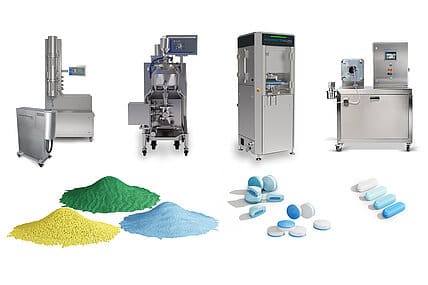
Advancements in miniaturized equipment are revolutionizing lab-scale production by offering compact, high-precision machines for various unit operations. These include microfluidic systems for nanomaterial synthesis, small-scale tablet presses with precise force control, Lab fluid bed granulators using the same technology like the production size for easy scale -up, and miniaturized reactors for chemical synthesis.
These compact machines enable faster formulation testing by allowing researchers to rapidly prepare and analyze small quantities of numerous formulations with minimal material. The benefits of scalable technology that bridges lab-scale to full-scale production are immense. For instance, some miniaturized equipment utilizes the same underlying principles and control systems as their larger counterparts, facilitating smoother technology transfer and reducing scale-up risks. This ensures that processes developed at lab scale are more likely to be reproducible and efficient at commercial scale.
B. Automation & Robotics in Lab Manufacturing
Automated dosing, mixing, granulation and tablet compression systems are increasingly being implemented in lab manufacturing to enhance precision and throughput. Automated dosing systems ensure accurate and reproducible dispensing of liquids and powders, minimizing human error. Automated mixers provide consistent blending and homogenization, while automated tablet presses offer precise control over compression force and tablet dimensions.
Robotic arms and AI-driven systems further improve precision and efficiency by automating repetitive tasks such as sample handling, loading and unloading equipment, and performing complex manipulations with high accuracy. AI algorithms can analyze process data in real-time, optimize parameters, and even predict potential issues, leading to more robust and efficient lab-scale manufacturing.
C. Sustainable & Green Manufacturing Approaches
The rise of eco-friendly lab-scale manufacturing is driven by increasing environmental awareness and the need to reduce costs. Advanced technologies are contributing significantly to this shift.
Advanced technologies help reduce solvent waste through the implementation of microfluidic reactors that require significantly smaller volumes of solvents, the use of supercritical fluids as greener alternatives, and the development of efficient solvent recovery and recycling systems. Energy consumption is being reduced through the use of energy-efficient miniaturized equipment, optimized reaction conditions, and the integration of smart monitoring systems that allow for process optimization and minimization of unnecessary energy usage.
D. Smart Monitoring & Data-Driven Process Optimization
Internet of Things (IoT)-enabled monitoring systems are revolutionizing process control in lab-scale manufacturing. These systems utilize sensors to continuously monitor critical process parameters such as temperature, pressure, pH, flow rate, and mixing speed. This real-time data is then transmitted to a central system for analysis and visualization.
Benefits of real-time analytics include:
- Improved Efficiency: Real-time data allows for immediate identification and correction of process deviations, minimizing downtime and maximizing yield. Trends can be analyzed to optimize process parameters for better efficiency.
- Enhanced Compliance: Continuous monitoring provides a comprehensive audit trail of process parameters, facilitating regulatory compliance by demonstrating process consistency and control. Real-time alerts can notify operators of deviations that could impact product quality.
- Increased Product Quality: Continuous monitoring ensures that the process operates within defined parameters, leading to more consistent and higher-quality drug products.
- Faster Troubleshooting: Real-time data and analytics enable quicker identification of the root causes of process issues, facilitating faster troubleshooting and resolution.
3. Regulatory Compliance & Quality Control in Lab-Scale Manufacturing
While lab-scale manufacturing operates under less stringent regulations than commercial production, regulatory compliance and quality control are still paramount. Meeting standards set by the FDA, EMA, and cGMP (current Good Manufacturing Practices), where applicable, ensures the generation of reliable and traceable data that will be crucial for future regulatory submissions.
Important aspects of regulatory compliance and quality control in lab-scale include:
- Adherence to Good Laboratory Practices (GLP): Ensuring proper documentation, equipment calibration, personnel training, and data integrity.
- Establishment of basic quality control procedures: Implementing in-process controls and testing to ensure the quality of the materials produced.
- Traceability of materials and processes: Maintaining detailed records of all materials used, process parameters, and analytical results.
- Validation of analytical methods: Ensuring that the methods used for testing are accurate, reliable, and reproducible.
The important role of real-time data tracking in regulatory compliance cannot be overstated. Real-time data provides a continuous record of the manufacturing process, demonstrating adherence to pre-defined parameters and facilitating the identification of any deviations. This comprehensive data trail is invaluable for regulatory audits and ensures the integrity and reliability of the generated material and associated data.
4. Future Trends in Lab-Scale Pharmaceutical Manufacturing
The future of lab-scale pharmaceutical manufacturing will be significantly shaped by the integration of cutting-edge technologies:
- Integration of AI and ML for Process Simulation and Optimization: Artificial intelligence (AI) and machine learning (ML) algorithms will be increasingly used to analyze vast datasets from lab-scale experiments to simulate different process scenarios, predict optimal formulation parameters, and optimize manufacturing processes for efficiency and quality. Digital twins, virtual representations of the physical manufacturing process, will allow for in silico experimentation, reducing the need for extensive lab-based trials.
- 3D Printing for Personalized Drug Formulation: 3D printing is revolutionizing drug formulation by enabling the creation of personalized dosage forms with tailored drug release profiles, shapes, and sizes. At lab scale, 3D printing allows for rapid prototyping and testing of these novel formulations.
- Nanotechnology for Enhanced Drug Delivery: Nanotechnology is enabling the development of novel drug delivery systems with improved solubility, bioavailability, and targeted drug release. Lab-scale production plays a crucial role in synthesizing and characterizing these nanomaterials and incorporating them into innovative formulations.
5. How Romaco Supports Innovation in Lab-Scale Manufacturing
Romaco is at the forefront of supporting innovation in lab-scale pharmaceutical manufacturing by offering a comprehensive range of state-of-the-art laboratory solutions:
- Precision Processing Equipment: Romaco provides a variety of high-precision laboratory equipment for key unit operations, including small-scale single punch tablet presses with precise force control and the ability to mimic a production scale press profile, laboratory fluid bed systems for granulation and coating, and laboratory mixers and blenders ensuring homogeneity and reproducibility.
- Automation & Robotics Integration: Romaco offers solutions for integrating automation and robotics into lab workflows, including automated dispensing systems, robotic arms for sample handling, and software for process control and data management, enhancing precision and efficiency.
- Scalable & Sustainable Solutions: Romaco designs laboratory equipment with scalability in mind, often utilizing the same core technologies as larger-scale industrial machines. Furthermore, Romaco emphasizes sustainable solutions with features that minimize material usage and energy consumption.
- Regulatory-Compliant Technology: Romaco’s laboratory equipment and software are designed to facilitate compliance with relevant regulatory guidelines, including features for data integrity, audit trails, and process documentation.
Conclusion
The landscape of pharmaceutical lab-scale manufacturing is undergoing a profound transformation driven by impactful key innovations such as advanced miniaturized equipment, automation and robotics, continuous manufacturing, sustainable approaches, and smart monitoring with data-driven optimization. These advancements are fundamentally changing how drug development and formulation testing are conducted, leading to increased efficiency, enhanced precision, and improved sustainability. The integration of advanced technology and automation streamlines workflows, while a strong focus on regulatory compliance ensures the generation of high-quality, traceable data. We encourage researchers and pharmaceutical companies to explore Romaco’s state-of-the-art lab-scale solutions to unlock enhanced efficiency, achieve greater sustainability, and ensure the precision required to drive pharmaceutical innovation forward.
FAQ
What are lab-scale formulation services in pharmaceutical manufacturing?
Lab-scale formulation services represent the initial R&D phase in drug development where scientific concepts are converted into physical prototypes. These services utilize specialized, small-scale equipment to systematically test excipients, dosage forms, and processing parameters. The objective is to evaluate a drug candidate’s physicochemical properties, solubility, stability, and bioavailability, effectively filtering out unsuitable candidates before committing to high-cost, large-scale manufacturing.
What is pharmaceutical lab optimization and why is it important?
Pharmaceutical lab optimization is the application of data-driven methodologies and automated technologies to refine drug development workflows. It focuses on identifying Critical Process Parameters (CPPs) and their influence on Critical Quality Attributes (CQAs).
Why it is important:
- Scalability: Ensures that lab processes are inherently compatible with industrial-scale equipment, reducing technology transfer risks.
- Efficiency: Uses robotics and real-time IoT monitoring to reduce manual error and increase throughput.
- Regulatory Compliance: Maintains rigorous data integrity and audit trails required by agencies like the FDA and EMA to validate process consistency.
What is laboratory production in pharmaceutical manufacturing?
Laboratory production is the process of manufacturing small, controlled batches of drug products for experimental and validation purposes. It serves as the vital bridge between early-stage discovery and commercial production.
Key functions include:
- Testing initial chemical entities for clinical potential.
- Producing sufficient drug quantities for in vitro and in vivo safety and efficacy testing.
- Providing data-backed evidence for intellectual property (IP) protection and funding.
- Establishing a robust “manufacturing recipe” that can be successfully scaled up to full production volumes.