
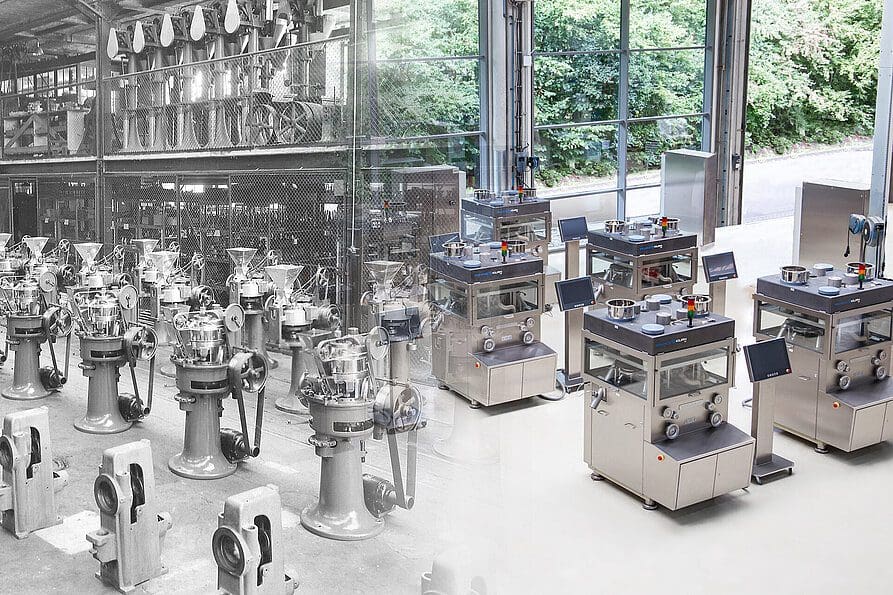
Romaco is a global supplier of pharmaceutical machinery and integrated system solutions. Renowned for its innovative approach and high-quality equipment, Romaco has established itself as a leader in the industry. One of Romaco’s core competencies is the production of tablet presses. These machines are an indispensable part of the production process for a wide range of pharmaceutical and non-pharmaceutical products. Romaco’s tablet presses are designed to meet the demanding requirements of the pharmaceutical industry, ensuring precision, efficiency, and compliance with industry standards.
The pharmaceutical industry is characterized by rapid advancements in technology, evolving regulatory requirements, and increasing consumer expectations. To stay competitive and meet these challenges, continuous innovation is crucial. Romaco is aware of these challenges and is committed to investing heavily in research and development. By continually improving its machinery and introducing new technologies, Romaco enables pharmaceutical manufacturers to enhance their production capabilities.
Evolution of tablet press technology
The beginnings of tablet production
The concept of administering pharmaceuticals in tablet form is relatively recent development, particularly in comparison to other pharmaceutical dosage forms. The first attempts to compress powdered substances into tablets date back to the 19th century, utilizing hand-operated. These early tablet presses were relatively simple in design and operated manually. They employed a plunger to compress the powdery substance into a mold and then into a tablet. However, this method was both very time-consuming and prone to inconsistency in tablet quality.
The revolution of the rotary tablet press
The rotary tablet press marked a significant turning point in the industry. These machines enabled the continuous production of tablets, replacing the slow and imprecise manual presses. Fritz Kilian (today Romaco Kilian, a subsidiary of the Romaco Group) was integral to this advancement. In 1885 he applied for the first patent for a rotary tablet press. This basic principle still forms the basis for most modern tablet presses today.
The rotary tablet press offers several advantages, including a higher production speed and the ability to produce tablets of superior quality tablets. Uniform pressure and the capacity to produce larger quantities of tablets are two key benefits.
The most important improvements to rotary tablet presses include:
Innovative designs: Romaco has introduced innovative tablet press designs that improve efficiency, reduce downtime, and enhance product quality.
Advanced automation: Romaco has integrated advanced automation systems into its tablet presses, enabling greater precision and control.
Integration with other equipment: Romaco has developed solutions that seamlessly integrate tablet presses with other pharmaceutical machinery, creating efficient production lines.
Compliance with industry standards: Romaco’s tablet presses are designed to meet the stringent regulatory requirements of the pharmaceutical industry, ensuring product and operator safety as well as optimum quality.
Customization: Romaco offers customizable solutions to meet the specific needs of its customers, whether it’s for small-scale production or large-scale manufacturing.
Further developments and innovations
Over the course of the 20th century, tablet presses were continuously enhanced and improved. The incorporation of automated technology has facilitated enhanced precision in production operations and increased overall efficiency. The development of new materials for the tools and the tablets themselves has resulted in an improvement in the shelf life and release of the active ingredients. Furthermore, modern tablet presses are controlled and monitored by computers, enabling even greater precision and flexibility.
The importance of the tablet press today
Tablet presses are indispensable tools in the pharmaceutical industry today. They enable the fast, efficient and cost-effective production of billions of tablets per year. Tablet presses are not only used in the pharmaceutical industry, but also in the food, cosmetics and chemical industries. Research and development in this area focuses on improving production speed, increasing flexibility and minimizing waste.
Benefits of Romaco Kilian’s tablet presses
The Romaco Kilian brand is well-known in the industry for its high-quality tablet presses, which offer a range of benefits to pharmaceutical manufacturers.
Here are just some of key benefits of the Romaco Kilian tablet presses:
Increased efficiency
Continuous production: Romaco Kilian’s tablet presses are designed for continuous operation, maximizing output and minimizing downtime, to ensure optimal efficiency and productivity.
High-speed production: These machines are capable of producing a significant number of tablets per hour, increasing overall productivity.
Quality assurance
Precision and consistency: Romaco Kilian’s tablet presses ensure precise tablet formation and consistent weight, ensuring product quality and compliance with regulatory standards.
Robust construction: Romaco Kilian’s tablet presses are constructed with high-quality materials and robust construction techniques to ensure durability, minimize downtime and guarantee reliable operation.
Cost savings
Reduced waste: Romaco Kilian’s tablet presses minimize waste, such as product loss during production, leading to significant cost savings.
Energy efficiency: The machines are designed to be energy-efficient, reducing operating costs.
Long-term reliability: Romaco Kilian’s commitment to quality and durability ensures that its tablet presses provide long-term value and minimize maintenance costs.
The future of tableting
Romaco began integrating predictive maintenance technologies into its pharmaceutical machinery at an early stage. This innovative approach utilizes data analytics and machine learning to predict potential equipment failures before they occur, enabling proactive maintenance and minimizing downtime.
The following are the most significant aspects of Romaco’s advancements in predictive maintenance:
Sensor integration: Romaco equips its machinery with a variety of sensors that collect real-time data on equipment performance, including vibration, temperature, pressure, and power consumption.
Data analytics: Advanced data analytics algorithms analyze the collected sensor data to identify patterns, anomalies, and potential indicators of equipment degradation.
Maintenance scheduling: The predictive models help determine optimal maintenance schedules, preventing failures before they occur and minimizing unplanned downtime.
Remote monitoring: Romaco’s predictive maintenance solutions include remote monitoring capabilities, allowing for real-time tracking of equipment health and early detection of potential issues.
Benefits of predictive maintenance:
Reduced downtime: By anticipating equipment failures, predictive maintenance helps minimize unplanned downtime, improving overall production efficiency.
Optimized maintenance: Predictive maintenance enables more targeted and efficient maintenance activities, reducing costs and improving equipment reliability.
Improved equipment lifespan: By addressing potential issues proactively, predictive maintenance can extend the lifespan of pharmaceutical machinery.
Enhanced quality control: Predictive maintenance helps ensure consistent equipment performance, leading to improved product quality and reduced defects.
Conclusion
Romaco has reinforced its status as a leading supplier of pharmaceutical machinery, particularly in the field of tablet presses. By combining innovative designs, advanced technology, and a strong commitment to quality, Romaco has contributed significantly to the evolution of the pharmaceutical industry.
By investing in research and development, Romaco continues to advance the state of tablet press technology, offering solutions that enhance efficiency, improve product quality, and reduce costs. As the pharmaceutical industry faces increasing demands for precision, speed, and compliance, Romaco’s tablet presses remain a valuable asset for manufacturers seeking to optimize their production processes and deliver high-quality products to market.