
In the pharmaceutical industry, packaging isn’t just about containing a product: it’s the silent guardian, ensuring that medications reach patients in their intended form, potency, and sterility.
Pharmaceutical packaging key roles entail robust product protection against environmental factors and physical damage, safeguarding delicate medications. With packaging facilitating accurate dosing, clear labeling, and child-resistant features, it’s immediately clear that the main goal is patient’s safety.
To combat counterfeiting, security features and serialization enhance product traceability. Sustainability is also a growing focus, driving the industry towards eco-friendly materials and designs.
In short, pharmaceutical packaging is a complex, regulated field where precision and patient well-being are the highest priorities.
The role of plastic ampoules in the pharmaceutical market
Among the diverse packaging solutions available, plastic ampoules play a critical role, particularly in the delivery of liquid medications. These single-dose containers offer precise dosing, minimize waste, and provide a barrier against external contaminants, ensuring the stability and efficacy of sensitive formulations. Their use is especially prevalent in applications requiring accurate, controlled administration, from eye drops to injectables.
When specifically comparing them to their glass-made counterpart, we can identify a few beneficial factors weighing in on the choice of using plastic ampoules:
- Reduced Breakage: Plastic is significantly less fragile than glass, minimizing the risk of breakage during transport, handling, and administration.
- Flexibility and Design: Plastic allows for more flexible designs and shapes, including easy-to-open formats and customized dispensing tips.
- Lightweight: Plastic ampoules are lighter than glass, potentially reducing shipping.
- Safety: Reduced risk of sharp glass shards in case of accidental breakage.
- Compatibility: Many plastics are highly compatible with a wide range of pharmaceutical formulations.
- Production cost: Generally speaking, plastic ampoules production can be cheaper than glass.
Plastic ampoules for pharmaceuticals require labeling; reason for this additional operation can be mostly tracked back to patient safety.
Labeling ensures correct medication administration through clear dosage and drug identification. Regulatory compliance mandates specific details like batch numbers and expiration dates for traceability. Accurate labels prevent medication errors, especially in complex healthcare settings. Tamper-evident features deter counterfeiting, safeguarding patients from harmful fake drugs. Labels also provide crucial instructions for use. Ultimately, labeling is not just a requirement, but a fundamental safety measure, guaranteeing product integrity and patient well-being throughout the pharmaceutical supply chain.
Labeling plastic ampoules presents unique challenges and considerations: it demands precision due to their small, curved surfaces and sensitive contents. Regulatory compliance require accurate product details, batch numbers, and safety warnings. Material compatibility is also an important factor in ensuring labels and adhesives are appropriate.
Printing technologies like inkjet or laser must deliver high-quality, durable prints that withstand handling and storage conditions.
Additionally, tamper-evident features, such as seals and holograms enhancing product security can be taken into consideration, as well as sustainable labeling materials, an increasingly favored option for many pharmaceutical companies in U.S. and Europe.
As per all operations involved in pharmaceutical production, rigorous testing must validate the labeling process, safeguarding product integrity and patient safety.
For this reason, automated labeling and vision systems undergo careful consideration to ensure accuracy and efficiency in high-volume production.
Technology significantly boosts labeling accuracy and efficiency in pharmaceutical packaging. Automated systems, integrated with vision technology, ensure precise label placement and verification, minimizing errors. Advanced printing techniques, like laser and inkjet, allow for high-resolution, variable data printing, crucial for serialization and traceability. Real-time data capture and analysis enable immediate quality control, reducing waste and downtime. These technologies streamline the labeling process, ensuring compliance with strict regulatory standards and enhancing overall production output.
Romaco expertise in pharmaceutical plastic ampoules labeling and packaging
Decades of experience in pharmaceutical secondary packaging have established this area as a core competency for Romaco, widely acknowledged within the industry.
Since the ‘90s we’ve navigated the diverse landscape of product handling, packing everything from delicate vials to complex medical devices. Our expertise shines in our commitment to customization. We understand that each pharmaceutical product demands appropriate, precise, sometimes unique handling. That’s why we place the product and customer specifications at the heart of every project, tailoring feeding systems and product handling to achieve optimal efficiency.
In addition to putting our in-house expertise at the service of the customer to configure the best solutions for each project, we have a proven track record of seamless cutting-edge technology integration.
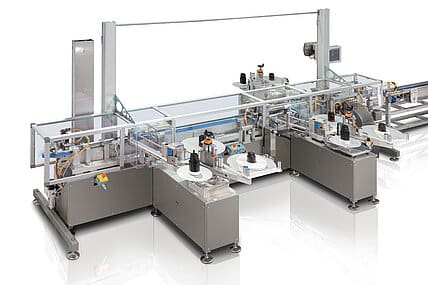
Our capacity to manage complex projects has been built in our development and supply of integrated technical solutions, including lines for plastic ampoule labeling, printing, and verification. With decades of experience, Romaco ensures that all ancillary systems and technologies are harmoniously integrated, maintaining the highest standards of quality and compliance. We deliver robust, reliable, and user-friendly solutions that meet the evolving needs of the pharmaceutical industry.
Our machines seamlessly incorporate labeling heads, managed by sophisticated control systems, along with printing and vision systems, all selected to meet client needs. Our flexibility extends to collaborating with third-party suppliers, enabling us to manage intricate, multi-equipment projects. This capability stems from our long-standing experience in both primary and secondary packaging, where we’ve mastered the integration of ancillary systems.
Romaco’s labeling and packaging solutions for plastic ampoules are designed for efficiency, precision, and accuracy. We’ve engineered machines to accommodate various ampoule orientations, such as vertical and horizontal carton packing.
As BFS products are common in hospital settings, we have successfully addressed the challenge of packaging multiple racks or stacks into single, large cartons.We also provided in-line cutting units that separate BFS racks into single ampoules, enabling flexible feeding, for example when single plastic ampoules need to be packed alongside different product types into the same carton.
Of course packaging pharmaceutical plastic ampoules into cartons presents challenges. Heavy cartons containing multiple products demand stable handling. Precise orientation and high-speed handling necessitate advanced automation. Accurate counting, labeling, and traceability are crucial for compliance. Carton integrity must withstand transit. We successfully designed our solutions taking into consideration all of these and many other potentials headaches, and are we are happy we have satisfied many pharmaceutical customers with our solutions.
Are you looking to enhance the efficiency and accuracy of your plastic ampoule cartoning processes? Are you targeting a new market segment? Reach out to us to discover how we can optimize your production.
About Romaco Contact us