
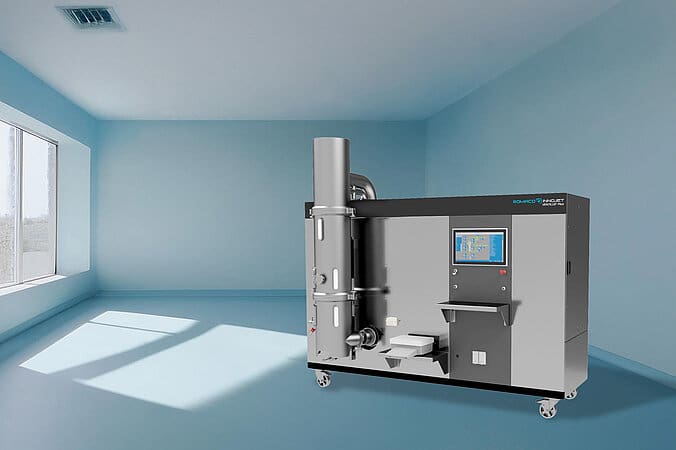
Fluid bed dryers are essential equipment in various industries, including pharmaceuticals, chemicals, and food processing. Their ability to efficiently dry and process materials with a faster drying time has made them a popular choice versus other traditional drying technologies. Also, the flexibility and variability of handling different process materials in a controlled environment, it is the preferable system to achieve good product quality at the end. However, selecting the right fluid bed dryer for specific needs can be a challenge. This article outlines key considerations to guide your decision-making process.
Introduction
A fluid bed dryer suspends particles in a stream of heated air, enabling rapid and uniform drying. This method is gentle on the product, minimizing degradation and ensuring consistent particle movement. Compared to traditional drying methods like oven drying or tray drying, fluid bed dryers offer superior efficiency, energy savings (faster process time), and product quality.
When choosing a fluid bed dryer, several factors must be carefully evaluated to ensure optimal performance and suitability for specific applications. Understanding the product’s characteristics, production requirements, and available resources is crucial for making a decision.
Key Considerations
Material Properties and Drying Requirements
The properties of the material to be dried significantly influence the choice of fluid bed dryer. Key considerations include:
- Particle size and shape: The dryer’s design should accommodate the material’s physical characteristics to ensure efficient drying. It is also important that the particles movement is homogeneous and controlled to get the best results.
- Heat sensitivity: Materials sensitive to heat require dryers with precise temperature control.
- Required final moisture content: The dryer’s capacity to achieve the desired moisture level is crucial. Other ancillaries can be offered to guarantee a constant RH of the inlet air from atmospheric variations (i.e. summer /winter season).
- Material inertness or sterility: For pharmaceutical or medical applications, the dryer must maintain a sterile environment e.g. clean room.
Versatility: Considering your future needs it might be important to execute also other operations like granulating, pellet coating or hotmelt coating in the same technology.
Production Capacity and Throughput
The scale of production operations directly impacts the dryer’s size and capacity:
- Batch size: The dryer should accommodate the desired batch size without compromising efficiency. Also should be ensured that an scale-up is possible.
- Drying time: The dryer’s performance should meet the required drying time for optimal productivity. Our Orbiter air distributor plate enhances the controllable particle movement being the most efficient drier in the market.
- Granulation and Coating: Depending on the application, the most flexible with one spraying nozzle for both can be an advantage.
- Production volume: Consider future production growth and select a dryer with sufficient capacity. Our Ventilus FB allows to work from 20% up to 85% of the nominal volume (depending on process application to be carried out). From 75 up to 1500 litters available.
Space Constraints and Layout
The available space for the dryer and its integration with existing production lines are essential factors:
- Floor space: Ensure the dryer fits the available space without hindering operations. Height can be an issue and a vertical or horizontal suite can facilitate the installation without any major civil work and planning permissions.
- Layout: Consider the dryer’s placement in relation to other equipment for efficient material flow. A vertical and closed system it is most favorable and following GMP guidelines in the industry. Using vacuum transfer and less manual intervention for product transfer is the safeties recommendations.
Efficiency and Budget
Economic considerations are crucial for any investment:
- Energy consumption: Efficient dryers minimize energy costs and reduce environmental impact. The heat recovery system HRS from Romaco for example is an optimal and patented system to reuse the heat loss and ultimately can save you up to 55 – 75% energy consumption with its different systems.
- Maintenance requirements: Easy maintenance and readily available spare parts contribute to lower operating costs.
- Initial investment cost: Evaluate the dryer’s price in relation to its expected benefits and return on investment. Not only the initial costs should be considered, it’s the TOC (total cost of ownership) that needs to be considered and makes an invest a good one.
Additional Features and Automation
Advanced features can enhance dryer performance and productivity:
- Safety using solvents: For materials with explosion risks, several systems must be taken into consideration for the safety of the operators. Our primarily choice is Pressure Shock Resistance (10 bar design) and measuring LEL Limit Explosure Level makes the safest system.
- Solvent recovery: For solvent-based processes, solvent recovery systems like scrubber, can improve efficiency and reduce costs.
- Automation: Automated control systems can optimize drying parameters and reduce labor requirements.
- Data acquisition and process control: Real-time monitoring and data logging enable process optimization and quality assurance. MES available and other audit trail systems are the preferable choice.
Conclusion
Selecting the right fluid bed dryer involves a careful evaluation of various factors, including material properties, production requirements, versatility, and budget. By considering these elements and consulting with experienced manufacturers, you can make an informed decision that maximizes efficiency, product quality, and profitability. Nowadays sustainability should also be a factor to consider when choosing equipment.
Considering these factors the Innojet Ventilus system provides a huge versatility (granulation, drying and coating) and offers a future proof concept enabling to process all these applications in one unique system. It can handle particles from 10 microns to 2mm. Its Orbiter air distributor plate guarantees a very homogenous and controlled particle movement, optimizing the fluidization achieving narrow particle size distribution. With the combination of Orbiter and Sepajet process filters, gentle product flow, shorter processing time as well as an excellent reproducible product quality is possible. The process time is optimized through continuous blow-back clearing the multiple filters (Sepajet). A linear scale-up (thanks to the Orbiter rings) is possible and helps you to shorten development times. Ventilus offers a lineal scalability making it simple and maintaining minimal changes from model to model. Compared to other systems the Romaco Innojet Sepajet filter system does not need compressed air while at the same time providing the same low relative humidity and temperature as the inlet drying air.
Remember, a well-chosen fluid bed dryer is an investment in your production process. Consulting with a reputable manufacturer can provide valuable insights and recommendations tailored to your specific needs.
Romaco always takes into consideration that you are investing in your future to enhance your production with a new fluid bed dryer and assists you in finding the best equipment for your specific needs. With a Romaco Innojet fluid bed dryer you can be confident to have the advanced technology to match also future needs.
FAQ
What is a fluid bed dryer and how does it work in pharmaceutical processing?
A fluid bed dryer is an advanced processing system used to remove moisture from solid particles—such as granules, pellets, or powders—in a highly efficient, uniform manner.
In pharmaceutical manufacturing, it works by suspending wet particles in a vertical column using a powerful stream of heated air. This state of “fluidization” causes the particles to behave like a fluid, allowing each individual particle to be surrounded by air. This ensures rapid, homogeneous heat and mass transfer, which significantly reduces drying times compared to traditional methods like tray or oven drying. Because the particles are in constant, gentle motion, the process prevents hotspots and degradation, resulting in a high-quality, reproducible end product essential for stable pharmaceutical dosage forms.
What are the top considerations when selecting a fluid bed dryer machine?
Selecting the right fluid bed dryer for pharmaceutical applications requires balancing product quality, regulatory compliance, and production throughput. When evaluating equipment, consider these top factors:
- Batch Size and Scalability: Ensure the machine capacity matches your typical batch sizes. A good dryer should offer high flexibility, allowing you to scale up from R&D and pilot-scale trials to full-scale commercial production without losing consistency.
- Containment and Operator Safety: Given the handling of potent APIs, assess the system’s containment levels (OEB ratings). Look for features like closed-loop transfer systems, inflatable seals, and advanced dust filtration to ensure maximum operator protection.
- Process Control and Automation: Precision is key. Choose a system with advanced automation (PLC/SCADA) that allows for real-time monitoring of inlet/outlet air temperature, humidity, and airflow. The ability to program and save specific “recipes” is vital for ensuring repeatable results. Romaco Innojet has it’s own modular SCADA system and it therefore able to handle customer specific requirements.
- Ease of Cleaning: To minimize downtime and prevent contamination, evaluate the machine’s design for Clean-in-Place (CIP) capabilities. Smooth surfaces, minimal dead zones, and modular components significantly simplify validation and cleaning protocols.
- Material of Construction: All product-contact parts must be made of high-quality, corrosion-resistant stainless steel (typically 316L) with appropriate surface finishes (Ra values) to comply with stringent GMP requirements.
- Drying Efficiency: Look at the airflow design and heat transfer capabilities. An efficient dryer should provide uniform air distribution to prevent product clumping or localized overheating, ensuring a gentle yet rapid drying cycle that protects sensitive active ingredients.
What are the most important criteria for choosing drying equipment for chemicals?
Selecting drying equipment for chemicals requires focusing on safety, material compatibility, and throughput. The most critical criteria include:
- Safety and Explosion Protection: Compliance with ATEX/NFPA standards is essential. Look for explosion relief valves, inert gas blanketing (nitrogen purging), and grounded systems to manage combustible powders and/or organic solvents.
- Material Sensitivity: Ensure the drying method matches your compound’s thermal limits. Some chemicals require low-temperature vacuum drying, while others can withstand high-speed heat.
- Corrosion Resistance: Use high-grade materials or specialized alloys (e.g., Hastelloy) if your chemicals are aggressive to prevent equipment degradation.
- Solvent Recovery: If working with VOCs, the dryer must integrate with a closed-loop condenser to ensure environmental compliance and cost-effective solvent recycling.
- Throughput & Changeover: Choose between batch or continuous processing based on your volume. If handling various products, prioritize a design that allows for rapid, thorough cleaning to avoid cross-contamination.
Which dryers are most efficient for heat-sensitive pharmaceutical products?
- For heat-sensitive pharmaceutical products, where maintaining chemical integrity and preventing degradation is paramount, the following drying technologies are the most efficient:
- Vacuum Drying: By lowering the atmospheric pressure inside the dryer, solvents or moisture evaporate at significantly lower temperatures. This is the gold standard for highly thermolabile substances, as it minimizes the risk of thermal degradation.
- Fluid Bed Dryers (with low-temperature settings): Modern fluid bed systems allow for highly precise control of inlet air temperature and humidity. By using high air volumes at lower temperatures, they enable rapid drying without exposing the product to the high heat that would trigger instability.
- Freeze Drying (Lyophilization): The most effective method for extremely sensitive products. It removes moisture through sublimation in a deep-vacuum, frozen state. This process eliminates heat-related stress entirely and is essential for products like proteins, vaccines, and biologics.
- Tray Drying (with vacuum): While traditional, when combined with vacuum, it remains a reliable and gentle option for smaller batches of highly sensitive materials where minimal mechanical stress is required.
Key Takeaway: The “most efficient” dryer is one that optimizes drying kinetics while keeping the product temperature well below its degradation threshold. For many pharma applications, a vacuum-assisted fluid bed dryer offers the best balance of speed and product protection.
How does the fluid bed dryer process improve drying uniformity and speed?
A fluid bed dryer optimizes both speed and uniformity by creating a “fluidized” state, where particles are fully suspended in a high-velocity, heated air stream. This process improves efficiency in two key ways:
- Enhanced Drying Speed (Mass Transfer): Because the heated air completely surrounds each individual particle, the surface area exposed to the drying medium is maximized. This creates ideal conditions for rapid evaporation and mass transfer, allowing moisture to escape significantly faster than in static drying methods like ovens.
- Superior Uniformity (Heat Transfer): The constant, turbulent motion of the particles ensures that every granule is exposed to the same air temperature and airflow, preventing hot spots or clumping. This consistent exposure leads to a highly uniform final moisture content across the entire batch, which is critical for meeting strict pharmaceutical quality standards.
By balancing these air dynamics with precise temperature control, a fluid bed dryer achieves a shorter, more predictable drying cycle while protecting the physical integrity of the product.
What production capacity factors should be evaluated before choosing a fluid bed dryer?
To ensure your fluid bed dryer matches your production needs, evaluate these key capacity factors:
- Batch Flexibility: Choose between fixed-volume chambers or modular systems with interchangeable product containers to handle varying batch sizes.
- Drying Kinetics: Faster drying cycles increase daily throughput. Factor in your product’s specific moisture content and evaporation rates to determine true capacity.
- Scale-Up Path: Ensure the equipment design allows for seamless scale-up from pilot to commercial production, avoiding the need for costly re-validation.
- Air Handling Capacity: The blower must provide enough airflow to fluidize your specific product density. Undersized air systems lead to “dead zones” and reduced output.
- Automation & Handling: Total capacity is heavily influenced by non-processing time. Automated loading and discharge systems significantly increase the number of batches you can process per shift.
- Footprint Efficiency: Consider the machine’s configuration (e.g., vertical vs. horizontal) to ensure it maximizes output within your existing cleanroom space.